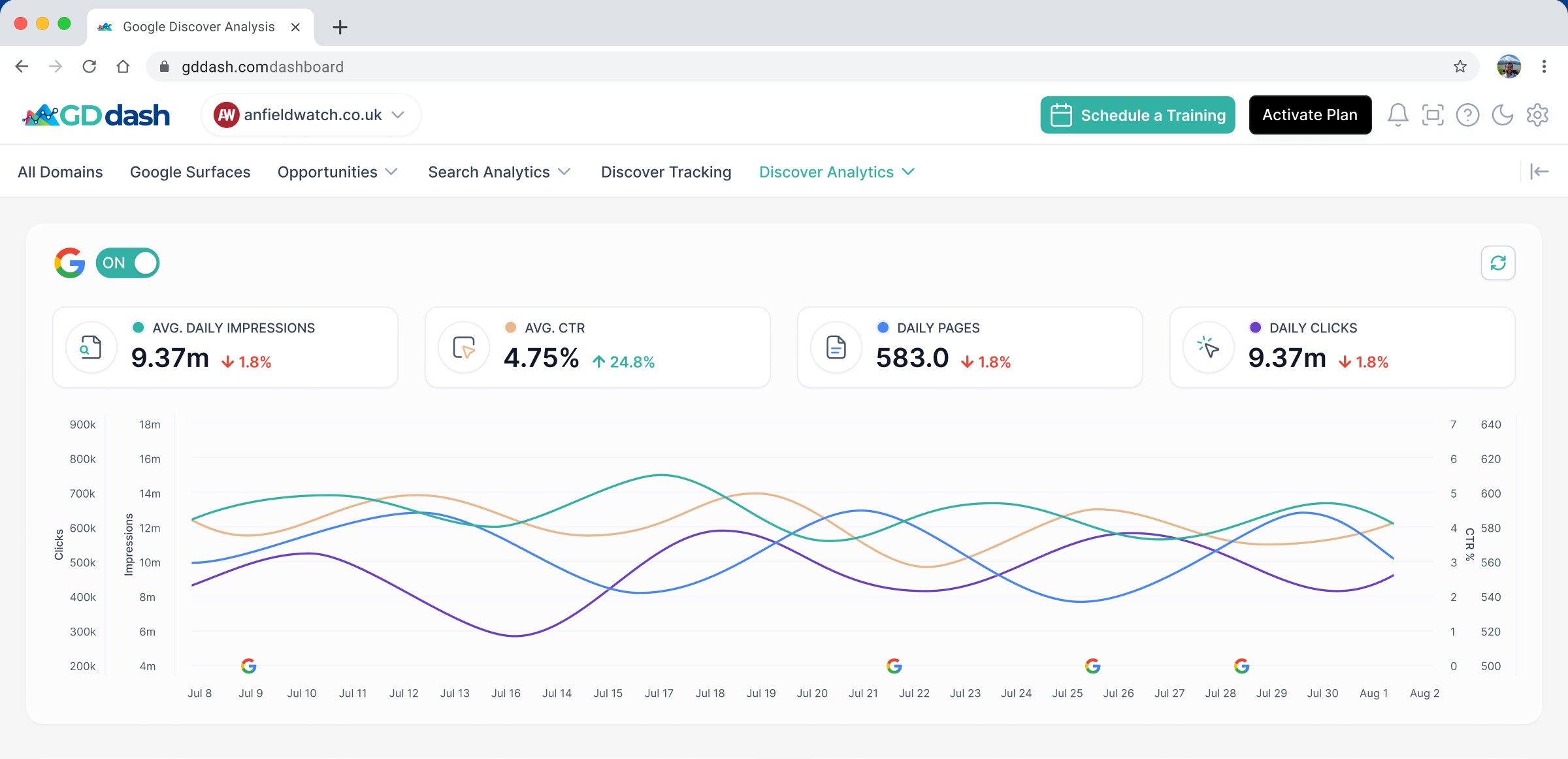
We track Google Discover and uncover which stories your audience get
AI Tracking
Real time notifications always keep you up to date.
Google Search Analytics
We track Google Discover and uncover which stories your audience get
Commerce
Real time notifications always keep you up to date.
Have Questions?
Talk to our team and they will help you out with everything you need
Written by
AI Overviews are quietly reshaping how billions of people find brands, experts, and ideas. But while we rely on AI for answers, where does it go for information? GDdash.com has it all
Using GDdash’s AI Tracker, which analyzed 36 million AI Overviews and 46 million citations between March and August 2025, we uncovered which domains Google’s AI cites most and how that trust varies by industry.
From Finance and Health to Gaming, E-commerce, and SEO, the findings reveal a clear pattern: AI blends institutional authority with community insight. Wikipedia and YouTube still reign supreme, but domain-specific experts such as NIH, Shopify, and ScienceDirect are emerging as trusted pillars within their niches.
The result is a new framework for visibility in search: to be discovered, you don’t just have to rank; you have to be citable.
List of contents
The Significance of Prestige and Popularity in Google’s Algorithm for News Sources.

The realm of news websites is expanding rapidly within the vast expanse of the web. With millions of URLs and a constant stream of new content being published every second, the task of crawling, indexing, evaluating, associating, and ranking this plethora of news posts demands robust servers and agile algorithms equipped with accurate features, samples, and decision trees.
According to the Chartbeat, everyday human-beings publishes 92.000 new articles (2016), according to the MarketingProfs, we post more than 2.000.000 articles everyday (2017).
Today, WorldOMeter also has a metric for posts that are written for everyday. And, usually it finishes every day with a 10.000.000 plus number.
In this article, I will explain possible methodologies of a Search Engine that can be used for ranking news sources and news articles along with summarizing the news articles. Thus, understanding a Search Engine’s obstacles for this fast-growing news ocean can help an SEO for emphasizing the Search Engine’s point of view.
News Sites are the biggest growing section of all web. Every news site has millions of URLs, and they are publishing every event for every second. Crawling, Indexing, Evaluating, Associating and Ranking all these news posts require strong servers and fast-reflexive algorithms with correct features, samples, decision-trees.

Source Rank Usage and Generation representation
News Sites are the biggest growing section of all web. Every news site has millions of URLs, and they are publishing every event for every second. Crawling, Indexing, Evaluating, Associating and Ranking all these news posts require strong servers and fast-reflexive algorithms with correct features, samples, decision-trees.
Be present where AI gathers its knowledge. Combine expert-driven articles with helpful videos, data-backed insights, and community engagement. Structure your content so it’s effortless for both users and AI to extract meaning.
Learn More
News Sites are the biggest growing section of all web. Every news site has millions of URLs, and they are publishing every event for every second. Crawling, Indexing, Evaluating, Associating and Ranking all these news posts require strong servers and fast-reflexive algorithms with correct features, samples, decision-trees.
Take a closer look at all the details with a full comparison of the packages, so you can choose the one that best fits your needs and goals.
If a News Source publishes a news story after an event, the time difference between the search demand occurrence and article publication might be used to determine the Breaking News Score. If the news source always publishes an original news story right after the search demand increases, Google might consider the News Source as a quality candidate for satisfying the sudden information need queries.
Google might determine the “time of the event” according to the news articles’ dates after clustering the news articles. In other words, it can check all of the dates for clustered articles and assume the first date as the time of the event. For this possibility, Google shared some formulas as below.
Don’t miss out the latest Google Discover trends by subscribing to our monthly newsletter
We care about your data in our privacy policy.
Let people know your opinion
Don’t miss out the latest Google Discover trends by subscribing to our monthly newsletter
We care about your data in our privacy policy.
Take a closer look at all the details with a full comparison of the packages, so you can choose the one that best fits your needs and goals.